
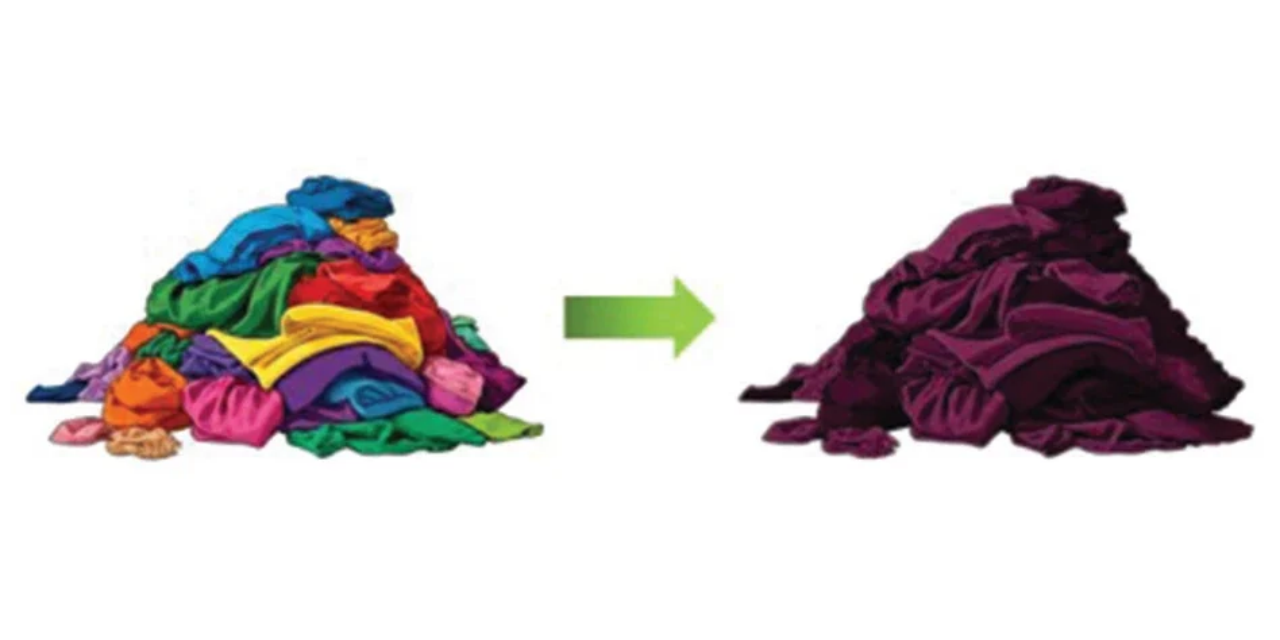
Researchers at the University of Fukui in Japan have developed a promising method for recycling coloured polyester textiles by redistributing existing dyes using supercritical carbon dioxide (scCO₂). The technique could reduce the need for chemical dye removal and support more sustainable textile recycling.
Coloured polyester is difficult to recycle because removing dyes often requires significant amounts of water, chemicals and energy. The researchers highlight the need for improved recycling technologies as textile waste continues to pose environmental challenges.
The study, published in The Journal of Supercritical Fluids, explored how supercritical carbon dioxide can penetrate polyester fibres and help dye molecules move between fabrics of different colours. By adjusting the proportions of coloured fabrics and controlling treatment time, the researchers produced new, uniform shades without first removing the existing dyes or adding new ones.
The experiments were conducted at 120°C and 25 MPa. Researchers combined polyester fabrics dyed in different colours and monitored changes in colour strength. Their findings also helped them develop a model to predict the resulting shades based on the proportions of the starting fabrics.
The research team included Senior Assistant Professor Jianhua Ren, Professor Kazumasa Hirogaki and researcher Isao Tabata. According to the researchers, microscopy indicated that the dyes were distributed evenly while the fibre microstructure remained unchanged.
The method could create new opportunities for fibre-to-fibre recycling, particularly for coloured polyester materials that are difficult to process using conventional techniques.
However, the research remains at the laboratory stage. Further testing is required using real textile waste, more complex dye combinations and larger-scale processing to establish the method's practical potential for the textile industry.


No comments yet. Be the first to share your thoughts!